Posts

Showing posts with the label listening to joni

listening to joni: #17 and final: shine

Image
Shine , 2007 Shine  is Joni's most recent, and likely final, studio album. She came out of retirement in 2007 to release the album, nine years after her previous Taming the Tiger. Shine , which was also re-issued on vinyl in 2020, is a themed collection: the lyrics focus on environmental destruction and endless war. Joni composed some of the tracks for The Fiddle and the Drum , a collaboration with the Alberta Ballet Company, for which Joni served as artistic director.   At the time of the album's release, most critics interpreted the lyrics as references to Hurricane Katrina and the US's invasion of Iraq. Today, not tethered to specific recent events, the songs ache with heartbreak, frustration, and anger at how we humans have destroyed our planet.    The album opens with an instrumental, "One Week Last Summer". When I first heard it, I thought it was a bit " Joni by the numbers," that Joni was musically repeating herself or relying too much on old patt...

the post of orphaned notes

Like many writers, especially those of us who grew up before the digital age, I keep a notebook. I use it to capture ideas, capture thoughts about I'm reading, take notes on experiences, and take notes on various activist or community meetings I attend.  I've learned that I have to make notes while I'm thinking of something, because I am unlikely to remember the thought at another time, out of context. Before the digital age, I carried a small spiral memo pad with me almost all the time.  These days, however, I don't always have a notebook with me, so I do whatever is quickest -- type a note on my phone, scribble it on a scrap of paper, save an email in drafts, or email myself from one address to another. Later on, when I'm blogging, I check my notebook to see my notes. But I don't look at the notes on my phone or the scraps of paper sitting in a neat pile on my desk or any other form of notetaking. My note-capturing process has changed, but my writing process ...

listening to joni: #16: taming the tiger

Image
Taming the Tiger , 1998 Taming the Tiger is markedly different than Joni's previous album, Turbulent Indigo . Where Turbulent Indigo is dark, intense, and enigmatic, and the lyrics largely topical, this one has a light, lyrical feel, the music shimmering and weightless, the lyrics more personal. Many critics regard it as Joni's best "latter day" album, perhaps because it's more accessible. I wouldn't go that far -- Turbulent Indigo and Night Ride Home are both better, in my view -- but Taming the Tiger is a solid album. To me, the name of the album and the title track are self-referential -- Joni, the fierce and dangerous tiger is now a domestic house cat. But in every cat there lurks some tiger; after all, this is "taming", a process, not past tense.  The title song's refrain see-saws us from the house cat to the tiger and back, using bits from the William Blake poem to a new purpose. Tiger tiger burning brightly (You can't tame the ti...

listening to joni: #15: turbulent indigo

Image
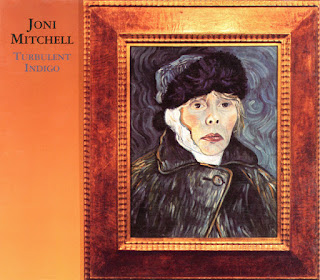
Turbulent Indigo , 1994 Front Cover Turbulent Indigo is a rich album, one that demands repeated listening. Every time I hear it, I discover new sounds and meanings, and I find that it has slyly become one of my most beloved of Joni's work. The name of the album is itself enigmatic. Many reviewers have noted that it echoes an earlier masterpiece, since the colour indigo is a form of blue. I don't find much in common between 1972's Blue  and this one. On Turbulent Indigo , the music is sparse, and the lyrics mostly look outward in social commentary, nothing like the deeply personal lyrics of Blue  with resounding piano. Given the nature of the songs, the album title seems to refer to the times we live in, the turbulence and dark colours of our contemporary world. The title may also reference the violence and inhumanity associated with indigo, the substance: it was part of the slave trade for hundreds of years. (Interesting tangent: the International Center for Indigo Cul...

listening to joni: #14: night ride home

Image
Night Ride Home , 1991 Although I mostly enjoyed Joni's previous album, Chalk Mark In a Rainstorm , I still harboured a nagging doubt and vague dislike. Both Chalk Mark (1988) and Dog Eat Dog (1985) didn't feel like Joni to me. I don't mean that they didn't repeat some formula or sound. I hope it's obvious that I don't approach music from that point of view. Those two albums had a cold, flat, pop-synth feel. Re-reading my posts about them, I noticed I wrote almost exclusively about the lyrics. It was as if I hadn't even heard the music. So I went back for another listen, and it was no accident -- you don't hear the music. It's vague, cold, and indistinct. Night Ride Home ends that unwelcome trend. You can hear Joni's playing and her arranging, and it's a welcome sound -- warm, intimate, distinctly musical, rather than synthetic. Joni's acoustic guitar, Larry Klein's bass, and some beautiful percussion by both Klein and Alex Acuna...

listening to joni: #13: chalk mark in a rainstorm

Image
Chalk Mark In a Rainstorm , 1988 After writing my first negative review in this series, I was half-dreading listening to the album. Happily, I ended up pleased and relieved. Chalk Mark In a Rainstorm is a solid album with some lovely and memorable songs. There are choices that don't work for me, and one truly awful song, but overall the album is a great improvement over the previous Do g Eat Dog . On Chalk Mark , Joni's writing is strongest when she's at her most topical. "Tea Leaf Prophecy," quotes the old spiritual and anti-war song "Down by the Riverside," using one of my most cherished lines, "study war no more". The song tells an unlikely love story of two people who met during the Second World War -- inspired by Joni's own parents. With the song's rhythmic refrain "study war no more" and "lay down your arms," not only have the lovers chosen love over war, but we are asked to do the same. In "The Beat of ...

listening to joni: #12: dog eat dog

Image
Dog Eat Dog , 1985 Front Cover We've reached a milestone: a Joni Mitchell album I don't like. No, that's a cop out. It's not merely that I don't like Dog Eat Dog . It's that Dog Eat Dog is not good. It's a really bad album. All musicians, all artists, create clunkers sometimes -- especially if they're experimenting and expanding. Bob Dylan, Bruce Springsteen, Elvis Costello, Van Morrison, David Byrne -- musical giants all, and all have released albums that aren't very good. And although it pains me to write this, Joni is not the exception. I stopped reading David Yaffe's biography of Joni while I was writing this blog series, so I don't know the history behind Dog Eat Dog . (I will go back and finish the book.) I don't know if Joni was pressured to try a more commercial sound, or if she genuinely wanted this album to sound and feel the way it does, or if perhaps the final result didn't reflect her intentions. The overall effect is t...

listening to joni: #11: wild things run fast

Image
Wild Things Run Fast , 1982 Front Cover Wild Things Run Fast feels like the beginning of a new Joni era. Mingus ended a trajectory. After Mingus , Joni toured, and took a break from recording. From now on she would release an album every three or four years, rather than annually as she once did. For me, Wild Things is an easy album to enjoy. It's tuneful and accessible, Joni's voice velvety over well-honed pop-jazz. With the opening notes of the first track, "Chinese Cafe/Unchained Melody", you know you're in familiar territory, reminiscent of Hissing and Hejira , but simplified and streamlined. Back Cover I wonder if this lady has a hole in her stockings. "Chinese Cafe" laments lost youth, and the lost landmarks of youth, the paved-over paradise, not with a deep sadness, just a wistfulness, an acceptance. Joni sings to an old friend, as she did in "Song for Sharon". Careful listeners, hearing My child's a stranger, I bore her, but I co...

listening to joni: #10: mingus

Image
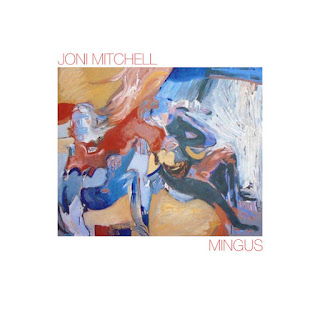
Mingus , 1979 Mingus is unique in Joni's work, in that she wrote lyrics to someone else's instrumental music. Four of the six tracks on Mingus were written collaboratively by Joni and Charles Mingus. Charles Mingus was a jazz composer and band leader. He was enormously influential, and anyone following contemporary jazz music would have known his work. But it's doubtful whether in 1979 most Joni Mitchell fans even knew his name, let alone recognized his music. In the late 1970s, Mingus had ALS and was failing physically. He reached out to Joni, and they began a long-distance friendship. After about a year, he asked Joni to write lyrics to a group of songs he had composed. The full story of how the collaboration began is more complex, but it wasn't known at the time. Mingus died before the album was finished, although he did hear finished versions of most of the songs. Mingus is another step on the jazz path Joni began with Court and Spark , and which became a greater...