Posts

Showing posts with the label what i'm reading

what i'm reading: sometimes you have to lie: the life and times of louise fitzhugh, renegade author of harriet the spy

Image
Until very recently, I didn't know anything about Louise Fitzhugh and had not thought about her at all.  Of course, as a child I read and loved Harriet the Spy , Fitzhugh's iconic and groundbreaking children's book. For a good portion of my life, I dreamed of writing a similar book. Many years ago, when I started writing serial fiction for a children's magazine, I bought a handful of tween books to re-read, and  Harriet  was among them. But I knew nothing about its author. On my birthday last year, my book-loving partner surprised me with a copy of  Sometimes You Have to Lie: the Life and Times of Louise Fitzhugh, Renegade Author of 'Harriet the Spy' . This was a thoughtful addition to my biography reading list . It was an inspired gift: the book turned out to be fascinating! Louise Fitzhugh's life was  very  interesting, and author Leslie Brody digs deep into the historical context, revealing several hidden histories along the way.  Louise Fitzhugh wa...

what i'm reading: the sword and the shield: the revolutionary lives of malcolm x and martin luther king jr.

Image
When I read a review of The Sword and The Shield: the Revolutionary Lives of Malcolm X and Martin Luther King, Jr. , I knew it was a book I'd been waiting for someone to write.  I despise the way Martin Luther King, Jr. has been sanitized and diluted for public consumption. The version of King that is widely celebrated is a pile of sentimental goo that the real King would not have recognized, let alone endorsed. King's radical legacy is reduced to a kind of bland "why can't we all just get along". His memory is used as a pacifier. King is officially lauded because of the fear of Black violence, and the ruling class' desire to promote docility among Blacks. So the public doesn't see King. Doesn't see the King who railed against the U.S. war in Southeast Asia, the King who marched with labour unions, the King who knew that without economic justice, desegregation was a hollow promise. The anti-capitalist King. The anti-imperialist King. The anti-war King...

beverly cleary, rest in peace, and thank you

Image
Beverly Cleary, who died last week at the astounding age of 104, was a pivotal figure in the world of children's literature. Her books are treasures; her influence can scarcely be measured. Cleary was one of the first authors to feature young characters who were realistically imperfect. If she was not  the  first, then certainly she was the first popular, widely-read writer who, as The Atlantic  put it, " saw children as they are ".  Before Henry Huggins and Ramona, before Otis and Ellen and Ralph S. Mouse, children's literature was preachy and moralistic. The sanitized characters bore little resemblance to actual children. Books typically stood above children, and spoke at  them. Cleary's books stood beside children and reflected them.  Cleary's books were among the first that  respected  children -- their intelligence, their experiences. This would become the norm, of course, but it started somewhere, and that somewhere is Beverly Cleary.  ...

what i'm reading: janis, her life and music

Image
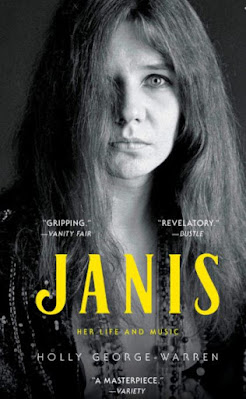
As a teenager and in my early 20s, I was somewhat obsessed with Janis Joplin. I read all the available biographies of her, and took any opportunity to see footage of her legendary performances. I never lost my fascination; I've continued to love Janis' music throughout my life. Reading Janis: Her Life and Music by Holly George-Warren deepened my appreciation of Janis' intelligence and artistry. The book also shifted my adult view of Janis, from a misunderstood, tragic figure, to a joyful, life-affirming woman intent on living life on her own terms. George-Warren was the first Janis biographer to have full access to all her diaries, journals, and letters, and truly, the first to care about facts . I didn't realize that Myra Friedman, author of the famous Janis biography Buried Alive (which I read and re-read) was in fact a publicist for Janis' record label. Turns out the book was mostly myth and rumour. * * * * Of course it is tragic that Janis died at only 27 years...

what i'm reading: the bridge by bill konigsberg -- important, powerful, essential teen fiction

Image
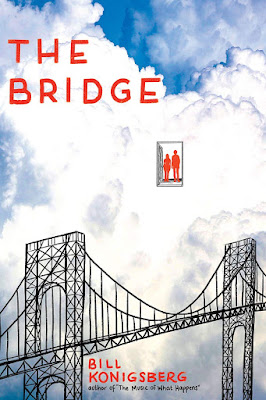
The Bridge , by Bill Konigsberg, is the best YA novel I've read since Eleanor & Park in 2012. Unfortunately, I know that many readers won't go near this book, because of its subject matter: teen suicide. This would be a terrible missed opportunity. It's a great book that both teens and adults -- especially adults who have contact with teenagers -- should read. Yes, it's sad, but it's also hopeful, and it's powerful, and it's necessary. Konigsberg, author of several excellent YA books, approaches the subject with a brilliant twist that makes the whole book work. Two teenagers stand on New York City's George Washington Bridge, feeling suicidal. They don't know each other; their presence on the bridge at the same moment is a coincidence, a quirk of fate, if you will. The story unfolds four times. She jumps, he doesn't. He jumps, she doesn't. They both jump. Neither jumps. Each timeline explores the ripple effect of each choice. Through this...

what i'm reading: ghosts of gold mountain, the epic story of the chinese who built the transcontinental railroad

Image
Ever since reading, in 2006, The National Dream and The Golden Spike , Pierre Berton's books about the building of the Canadian railroad, I've been interested in the Chinese railroad workers. Two details stuck in my memory: Chinese workers retaining their food traditions (and the racism and abuse they encountered over this) and that they went on strike . I was excited to know that these underpaid, undervalued, and abused workers organized themselves to fight back. So when I saw a very positive review of The Ghosts of Gold Mountain: The Epic Story of the Chinese Who Built the Transcontinental Railroad , I immediately requested it from my library. Gordon Chang, one of the preeminent historians of the Chinese experience in North America, writes from an American context, but the story applies to Canada and other countries, as Chinese labour built railroads all over the world. Outsized labour under outsized conditions To say that the Railroad Chinese (as they are called) toiled und...

a reading plan for 2021: big stacks of nonfiction, plus some fiction, and series for mind breaks

2018: Titles and reading projects that were languishing on my List . 2019: The year of the biography . The first time I created a reading plan for the year. 2020: I liked having the 2019 plan, and created a new plan for 2020 . In each case, I read many titles from the plan, and many off-plan -- enough that I feel I've accomplished part of a goal, but not so much that the goal became a chore.  For 2021, I consulted The List, and selected sub-lists of nonfiction, fiction, and YA. Add to that the authors I want to read or read more of (from the 2018 list), plus the long-term goals that may or may not advance.  Recently I made a brilliant discovery: I enjoy reading on the treadmill! I use a treadmill for exercise in bad weather or if for some other reason I don't want to outside. In the past I've always listened to music while walking to nowhere. A few weeks ago I tried reading, just as an experiment, and found that I love it. This new habit has made it possible to increase tim...

what i'm reading: never cry wolf by farley mowat

Image
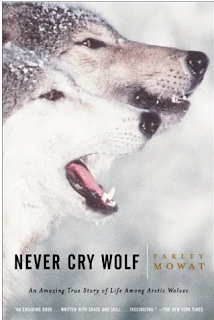
I have read many essays and op-eds by Farley Mowat , the legendary Canadian naturalist, but until now, had never read any of his many books. (He was incredibly prolific .) When visiting Russell Books in September, I noticed a copy of Never Cry Wolf  and picked it up. I'm so glad I did! It's a short, easy-to-read book that would appeal to any nature lover, not only wolf enthusiasts like me. Never Cry Wolf: The Amazing True Story of Life Among Arctic Wolves , first published in 1963, chronicles three seasons that Mowat spent observing wolves in the Keewatin Barrens, an area north of Manitoba, in the Northwest Territories. Farley was originally working for the government, sent to study how to control the wolf population that was supposedly laying waste to caribou herds. Armed with faulty equipment and faulty assumptions, Mowat discovered that everything the government -- and all of society -- believed about wolves was false.  Mowat camped in very close proximity to wolf families...

how do you read? in which my reading habits unexpectedly change

Image
Librarians like to ask readers about their reading habits. How do you read? What format do you most prefer? Do you have a secondary format? These days, most avid readers have found a use for e-books -- travel being the number one reason -- but generally prefer print. But some people read only e-books, and some only print. Many people listen to audiobooks in their car or during their commutes, often listening to one book and reading another. Some people are audio only, especially now that most audiobooks are available digitally. One book at a time, two books, multiple? Series? Every day, or how many days per week? What time of day? Where? Bed, couch, outside in good weather? How long do you give a book that you don't care for -- how many pages or chapters? (Please don't say you force yourself to read books you don't like! Life's too short and there are too many better books for you!) Do you ever go back to a book you didn't like... and does your opinion ever change? ...

the post of orphaned notes

Like many writers, especially those of us who grew up before the digital age, I keep a notebook. I use it to capture ideas, capture thoughts about I'm reading, take notes on experiences, and take notes on various activist or community meetings I attend.  I've learned that I have to make notes while I'm thinking of something, because I am unlikely to remember the thought at another time, out of context. Before the digital age, I carried a small spiral memo pad with me almost all the time.  These days, however, I don't always have a notebook with me, so I do whatever is quickest -- type a note on my phone, scribble it on a scrap of paper, save an email in drafts, or email myself from one address to another. Later on, when I'm blogging, I check my notebook to see my notes. But I don't look at the notes on my phone or the scraps of paper sitting in a neat pile on my desk or any other form of notetaking. My note-capturing process has changed, but my writing process ...

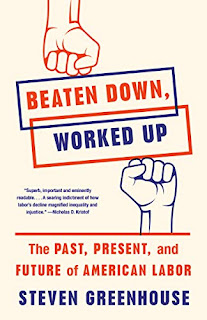
what i'm reading: beaten down, worked up: the past, present, and future of american labor

Image
Beaten Down, Worked Up: The Past, Present, and Future of American Labor by Steven Greenhouse is exactly what the subtitle says: a history and analysis of the rise, decline, and re-emergence of the labour movement in the United States. Although the context is American, the lessons in the stories easily apply to Canada, and perhaps globally, to labour movements everywhere.  Greenhouse covered labour issues for The New York Times for more than 30 years. It's obvious that the research for Beaten Down, Worked Up was vast and meticulous, but the book is never bogged down by too much detail. The writing is clear and accessible. Greenhouse is unapologetically pro-labour, but not a cheerleader for unions.  I found the book easy to read and compelling, and I recommend it highly both to readers of nonfiction with an interest in history and to labour activists. It should be required reading for all workers who are union skeptics! I really appreciated how this book was organized. Gre...

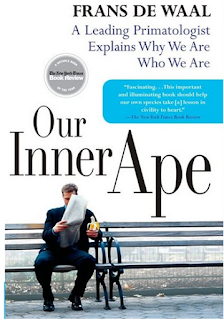
what i'm reading: our inner ape: a leading primatologist explains why we are who we are

Image
When I scroll through my ridiculously long book list, the name Frans de Waal appears again and again. I read reviews of his books, they sound appealing, they go on the list -- and there it ends. This has been going on since the 1990s, and now in 2020, I had yet to read one of his books.  Finally, my reading plan (originally here , with updates here and here ) put de Waal back on my radar. At Russell Books in Victoria , I found two of his books, and I put two more on hold at my library. I've read one so far, and I'm pleased to say I thoroughly enjoyed it. De Waal is a primatologist -- he studies primates, the group of mammals that includes apes and humans. He's that rare gem, a high-level scholar who writes with a breezy, accessible style, weaving wonderful examples from his own research and from popular culture. Our Inner Ape is de Waal's answer to a popular conception of humankind's "animal nature" -- the brutal, violent, combative human, which is kep...