Posts

Showing posts with the label poverty and class

topsy-turvy land: u.s. states make protest illegal and driving into protestors legal

Image
It seems that state lawmakers in several U.S. states need a refresher course on the First Amendment.  It's a very simple amendment, really.  Amendment I Congress shall make no law respecting an establishment of religion, or prohibiting the free exercise thereof; or abridging the freedom of speech, or of the press; or the right of the people peaceably to assemble, and to petition the government for a redress of grievances. While the beloved First Amendment has always been selectively applied -- cue the firehoses and Pinkertons -- its intent is quite clear and straightforward. Peaceful assembly and peaceful protest is legal. Full stop. Despite this, so far this year, 34 state legislatures have introduced more than 80 bills that very clearly aim to abridge and prohibit these inalienable rights. So far, four Republican governors have signed the measures into law. More are on the way. So far,  Florida has passed  the most draconian of these laws, creating a new, loosely d...

roots and icebergs: decolonizing community spaces: a workshop

Image
I recently attended a six-hour workshop called Decolonizing Community Spaces. The workshop was led by two facilitators, one a Native American speaking to us from her traditional territories in Montana, and the other a Filipina-Canadian.  About 30 people attended; I believe all were health and service providers in the province of BC.  All the other participants raved about how much they learned, and how they will change their daily practices accordingly. I don't know if they were exaggerating, or if they were starting from a different place than I was. I encountered few, if any, ideas that were new to me, and was left feeling hopeless about the prospects for change. This was clearly not the intended result! Making the invisible visible Much of the course was spent on activities aimed at making visible the many invisible forces and conditions that shape our world. My graduate school experience in Information Sciences often involved similar exercises. One often-used example is un...

things i heard at the library: an occasional series: #32

Image
I emailed this to my colleagues and our administrators; I should share it with wmtc readers, too. Along with many library workers, I am worried that our most vulnerable neighbours are being left behind. * * * * I just heard a heartbreaking lament from one of our regular customers, who was here for curbside. She told us that most people she knows do not have internet access or any TV service, and many do not have phones. They rely on library staff to suggest and order materials for them. We assured her that we can still do that. We asked her to encourage folks to show up during curbside hours and we will find books and DVDs for them. Then she said, “It’s not just the boredom. It’s the isolation. It’s the friendship. We are a poor community, and this library is our lifeline. I would work on the jigsaw puzzle or read a magazine, but that was just an excuse to be among people, to see friendly faces, to connect. The other place we would hang out is the Salvation Army – also closed. Many peo...

10 things on my mind about covid-19

Image
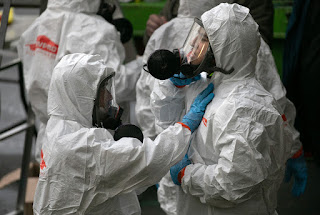
1. Wealthy urbanites are fleeing to their second homes -- buying out grocery stores, expecting personal shoppers and home delivery, swelling vacation towns' size to summer proportions. This is the epitome of the egocentric, classist arrogance that often pervades the United States. 2. In India , a planned lockdown of more than a billion people is expected to leave millions dead of starvation. As people become desperate, there will inevitably be rioting, police shootings, and all forms of rampant violence. In this case the response seems far worse than the pandemic itself. 3. Many people seem to have forgotten that the majority of COVID-19 case are not fatal. I'm not minimizing the potential, but numbers of confirmed cases does not equal the same number of deaths. 4. Our experience of the pandemic often depends on our employment situation. For me right now, it's a vacation. Health care workers have so much added risk and all the stress that comes with it. Supermarket workers...

how to afford a real social safety net: tax corporations, tax the rich, reduce u.s. military spending

Image
As waves of shelter-in-place orders sweep over the continent, Canada and the US must figure out how to support an entire population thrown into unemployment and in need of food, fuel, shelter, and in the US, health care. A brief dip into recent history provides two very simple answers. Demand corporations pay their share. The corporate tax rate is at an all-time low (for modern times), offshore tax havens are rampant, and as if that's not enough, in the US the largest corporations are now receiving tax rebates to the tune of $79 billion. Nearly 100 Fortune 500 companies effectively paid no federal taxes in 2018 , according to a new report. The study by the Institute on Taxation and Economic Policy, a left-leaning think tank, covers the first year following passage of the Tax Cuts and Jobs Act championed by President Donald Trump, which was signed into law in December 2017. The report covers 379 companies from the Fortune list that were profitable in 2018 and finds that 91 paid an ...

coronavirus exposes the darkest sides of unchecked capitalism and the gaping holes in our society

We're all struggling to take in the magnitude of coping with a global pandemic. Personally I've had to cancel a long-awaited vacation to vist family, and with libraries closed, I may soon be applying for EI. The shelves at our local supermarket are empty; we're hoping folks who did the right thing, remained calm and didn't hoard, won't be repaid with severe shortages. And of course I'm hoping that the relatively fast and decisive actions taken by Canada and my own province of BC will protect us from the worst. But I'm also acutely aware that my personal inconvenience is nothing compared to the misfortunes of so many others. I don't mean those who are necessarily sick with COVID-19. I'm thinking of those who simply cannot prepare, and those who are suddenly faced with a total loss of income. All the families who live paycheque to paycheque, cobbling together an income from various part-time and casual jobs, who suddenly find themselves unemployed. All...

things i heard at the library: an occasional series: #31

One of the most frustrating and sad things we encounter at the library are people we can't help, who don't understand why we can't help them -- and who blame us. These are generally people with minimal or no digital literacy (i.e. tech skills). Here's a typical scenario. A customer cannot access their email account because they have forgotten their password. It's likely they changed the password at some point but don't remember doing that, so they're using the old password, or that they're typing it in wrong. They claim they know their password, but it's not working. The password reset function requires a verification text sent to the phone number on file -- but that phone no longer exists. There are several ways this plays out. The customer blames the library computers, claiming that this never happened when they used the computers at [place where they used public computers in the past]. The customer blames library staff for being unwilling to help ...

laundromats, underground libraries, and criminal charges: a library link round-up

Image
I have so many cool stories about libraries and librarians, scattered through multiple email and social media accounts. Lucky for you, I wanted to gather them all in one place. Thanks to everyone who ever sent me one of these. * * * * * Librarians in laundromats! Community librarians are all about taking literacy to the people. In library jargon, we're trying to reach the non-users. If that sounds a bit drug-dealer-ish, it's not a bad analogy: come get a taste, then come back for more. The puns just write themselves: front-loading literacy , unhampered access... but the issue is deadly serious. You already know about food deserts. Well, there are book deserts , too. Neighbourhoods where libraries have been de-funded, bookstores are nonexistent, and families can't afford to buy books. In the US, great swaths of whole cities are book deserts. After all, there's no profit in bringing books to people who can't buy them. * * * * * Librarians as detectives! Meet the squa...

from the 2018 cupe ontario library workers conference: libraries and the opioid crisis

Image
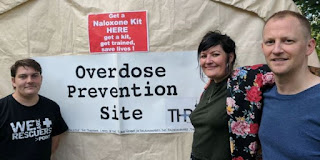
I recently attended the CUPE Ontario Library Workers Conference, which has become a highlight of my year since I first attended (and was elected to the organizing committee) in 2015. It has eclipsed and replaced the OLA Superconference as the most relevant and enjoyable must-attend conference in my schedule. When I first got my librarian degree, I was very excited about attending my first "OLA" (as it's always called). But I quickly learned that the sessions are a crap-shoot, sometimes relevant but often obvious and dull. There's also a great deal of boosterism by OLA and the member libraries. For the difference between the two conferences, for OLA, think employers and libraries , for CUPE Ontario, think  labour and library workers . In recent years, our Library Workers Conference has focused on precarious work and health and safety issues, two themes that are inextricably linked. This year's conference was called "Sex, Drugs & Bed Bugs," a light ...

required reading for revolutionaries: jane mcalevey and micah white

Image
I've wanted to write about these two books for a long time, but adequately summarizing them is a daunting task. I just want to say to every activist and organizer: READ THESE BOOKS . I don't want to represent the authors' ideas, I want you to read them yourself . No Shortcuts: Organizing for Power in the New Gilded Age by Jane F. McAlevey and The End of Protest: A New Playbook for Revolution by Micah White are both aimed at activists and organizers -- people who already believe in the need for social change and are trying to influence the world in a progressive direction. Both books identify pitfalls and shortcomings in the current ways we approach our activism, and they offer concrete ideas for change, along with theory and philosophy to guide our decisions. Both are beautifully written, powerful, and essential. No Shortcuts  focuses on the labour movement, but McAlevey's analysis could apply to any movement. The labour movement is an excellent lens through which to...

what i'm reading: pit bull: the battle over an american icon

Image
If you have an opinion about pitbulls, chances are good that it's based on myth, misinformation, and even disinformation. I know a good deal about dogs, and I thought  I knew a lot about pitbulls, yet I was constantly amazed and enlightened by Bronwen Dickey's Pit Bull: The Battle Over an American Icon . Here are some of the things you will learn if you read this book. There is no agreement on what a pitbull is . No one can correctly identify a dog's breed-mix based on the dog's appearance, including experts. Many or most media stories about pitbulls are based on uncorroborated heresay and myths, and many are actually fiction. Many dog-bite incidents reported as involving pitbulls actually involved Golden Retrievers, Dalmatians, Poodles, and other breeds. Accurate statistics about dog bites, especially those that account for severity, do not exist. There is nothing special about a pitbull's jaws or the strength of its bite. In fact, no test exists to measure the str...