Posts

Showing posts with the label history

what i'm reading: sometimes you have to lie: the life and times of louise fitzhugh, renegade author of harriet the spy

Image
Until very recently, I didn't know anything about Louise Fitzhugh and had not thought about her at all.  Of course, as a child I read and loved Harriet the Spy , Fitzhugh's iconic and groundbreaking children's book. For a good portion of my life, I dreamed of writing a similar book. Many years ago, when I started writing serial fiction for a children's magazine, I bought a handful of tween books to re-read, and  Harriet  was among them. But I knew nothing about its author. On my birthday last year, my book-loving partner surprised me with a copy of  Sometimes You Have to Lie: the Life and Times of Louise Fitzhugh, Renegade Author of 'Harriet the Spy' . This was a thoughtful addition to my biography reading list . It was an inspired gift: the book turned out to be fascinating! Louise Fitzhugh's life was  very  interesting, and author Leslie Brody digs deep into the historical context, revealing several hidden histories along the way.  Louise Fitzhugh wa...

what i'm reading: the sword and the shield: the revolutionary lives of malcolm x and martin luther king jr.

Image
When I read a review of The Sword and The Shield: the Revolutionary Lives of Malcolm X and Martin Luther King, Jr. , I knew it was a book I'd been waiting for someone to write.  I despise the way Martin Luther King, Jr. has been sanitized and diluted for public consumption. The version of King that is widely celebrated is a pile of sentimental goo that the real King would not have recognized, let alone endorsed. King's radical legacy is reduced to a kind of bland "why can't we all just get along". His memory is used as a pacifier. King is officially lauded because of the fear of Black violence, and the ruling class' desire to promote docility among Blacks. So the public doesn't see King. Doesn't see the King who railed against the U.S. war in Southeast Asia, the King who marched with labour unions, the King who knew that without economic justice, desegregation was a hollow promise. The anti-capitalist King. The anti-imperialist King. The anti-war King...

roots and icebergs: decolonizing community spaces: a workshop

Image
I recently attended a six-hour workshop called Decolonizing Community Spaces. The workshop was led by two facilitators, one a Native American speaking to us from her traditional territories in Montana, and the other a Filipina-Canadian.  About 30 people attended; I believe all were health and service providers in the province of BC.  All the other participants raved about how much they learned, and how they will change their daily practices accordingly. I don't know if they were exaggerating, or if they were starting from a different place than I was. I encountered few, if any, ideas that were new to me, and was left feeling hopeless about the prospects for change. This was clearly not the intended result! Making the invisible visible Much of the course was spent on activities aimed at making visible the many invisible forces and conditions that shape our world. My graduate school experience in Information Sciences often involved similar exercises. One often-used example is un...

what i'm reading: janis, her life and music

Image
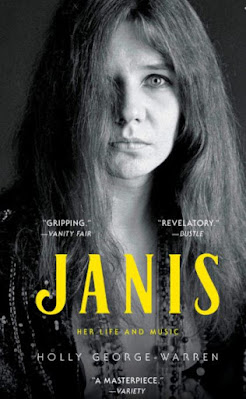
As a teenager and in my early 20s, I was somewhat obsessed with Janis Joplin. I read all the available biographies of her, and took any opportunity to see footage of her legendary performances. I never lost my fascination; I've continued to love Janis' music throughout my life. Reading Janis: Her Life and Music by Holly George-Warren deepened my appreciation of Janis' intelligence and artistry. The book also shifted my adult view of Janis, from a misunderstood, tragic figure, to a joyful, life-affirming woman intent on living life on her own terms. George-Warren was the first Janis biographer to have full access to all her diaries, journals, and letters, and truly, the first to care about facts . I didn't realize that Myra Friedman, author of the famous Janis biography Buried Alive (which I read and re-read) was in fact a publicist for Janis' record label. Turns out the book was mostly myth and rumour. * * * * Of course it is tragic that Janis died at only 27 years...

what i'm reading: ghosts of gold mountain, the epic story of the chinese who built the transcontinental railroad

Image
Ever since reading, in 2006, The National Dream and The Golden Spike , Pierre Berton's books about the building of the Canadian railroad, I've been interested in the Chinese railroad workers. Two details stuck in my memory: Chinese workers retaining their food traditions (and the racism and abuse they encountered over this) and that they went on strike . I was excited to know that these underpaid, undervalued, and abused workers organized themselves to fight back. So when I saw a very positive review of The Ghosts of Gold Mountain: The Epic Story of the Chinese Who Built the Transcontinental Railroad , I immediately requested it from my library. Gordon Chang, one of the preeminent historians of the Chinese experience in North America, writes from an American context, but the story applies to Canada and other countries, as Chinese labour built railroads all over the world. Outsized labour under outsized conditions To say that the Railroad Chinese (as they are called) toiled und...

fact: you cannot wave the confederate flag or the swastika flag and rightly call yourself a patriotic american

Image
This post has been half-written and sitting in drafts for many months. Days after an armed mob tried to violently subvert the results of an election seems like a good time to finish it. * * * * Here's a statement that should be completely obvious. You cannot wave the Confederate flag or the Nazi flag and also be a patriotic American. History Lesson #1 In 1861, a group of terrorists attacked the United States. This was an act of war, by a group who would soon be known as the Confederate Army.  Representing a self-declared country, the Confederate Army fought against the United States in a prolonged act of treason that lasted four years. 620,000 people died in this conflict, at a time when the population of the country (excluding Indigenous people) was about 31 million. Until 58,000 Americans lost their lives in the Vietnam War, more Americans were killed in the Civil War than in all foreign wars combined. Thus someone who waves the Confederate flag aligns themselves with treason an...

the post of orphaned notes

Like many writers, especially those of us who grew up before the digital age, I keep a notebook. I use it to capture ideas, capture thoughts about I'm reading, take notes on experiences, and take notes on various activist or community meetings I attend.  I've learned that I have to make notes while I'm thinking of something, because I am unlikely to remember the thought at another time, out of context. Before the digital age, I carried a small spiral memo pad with me almost all the time.  These days, however, I don't always have a notebook with me, so I do whatever is quickest -- type a note on my phone, scribble it on a scrap of paper, save an email in drafts, or email myself from one address to another. Later on, when I'm blogging, I check my notebook to see my notes. But I don't look at the notes on my phone or the scraps of paper sitting in a neat pile on my desk or any other form of notetaking. My note-capturing process has changed, but my writing process ...

what i'm reading: beaten down, worked up: the past, present, and future of american labor

Image
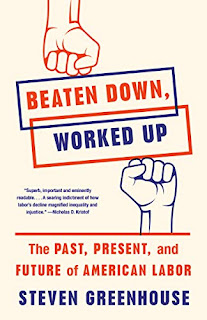
Beaten Down, Worked Up: The Past, Present, and Future of American Labor by Steven Greenhouse is exactly what the subtitle says: a history and analysis of the rise, decline, and re-emergence of the labour movement in the United States. Although the context is American, the lessons in the stories easily apply to Canada, and perhaps globally, to labour movements everywhere.  Greenhouse covered labour issues for The New York Times for more than 30 years. It's obvious that the research for Beaten Down, Worked Up was vast and meticulous, but the book is never bogged down by too much detail. The writing is clear and accessible. Greenhouse is unapologetically pro-labour, but not a cheerleader for unions.  I found the book easy to read and compelling, and I recommend it highly both to readers of nonfiction with an interest in history and to labour activists. It should be required reading for all workers who are union skeptics! I really appreciated how this book was organized. Gre...

africans were involved in the slave trade. why do you think that matters?

Image
The statement If you are exposed to any bigoted, right-wing media or social media -- whether by misfortune, sport, or a delusion that you must counter their arguments -- and someone raises the subject of slavery, you will doubtless see this trope.  They were sold by their own people. Africans sold other Africans. Slavery began in Africa, and was imported to the new world. In fact, you might hear or see some version of this any time racism is mentioned. Or as a complete non sequitur. It appears to be a wingnut favourite. They should stop complaining! Slavery is in the past! Get a life! And anyway THEY started it! Slavery was started in Africa! Blah blah blah!! Meaningless drivel!!  There are many myths and inaccuracies about slavery in the Americas -- this wrap-up in Slate is good -- but this one in particular interests me. Some facts We know that Black people were involved in the transatlantic slave trade. At any time, a handful of people, a few hundred -- perhaps over the ce...