Posts

three library issues, part 3: the human library

January 26, 2013 was the first Human Library Day , but the Human Library, also known as the Living Library , has been around for several years. The idea is to assemble a diverse group of people to be "books", then invite an audience to "borrow" the books by engaging them in conversation about themselves. The "book" person talks to the "reader" about her or his life, giving people an opportunity to interact with a greater range of human diversity than they might normally encounter. Human books might be called, for example, activist, musician, lesbian, Muslim, doctor, cancer survivor, wheelchair-user, kindergarten teacher, single parent. It's like a career day, on a broader scale. Sounds great, right? So why does it give me the creeps? When I first heard of the Human Library in one of my library courses, the idea made me cringe. It sounded like a jumped-up freak show, or a more socially acceptable version of "some of my best friends are......

three library issues, part 2: rfid self-checkout

Increasing numbers of public libraries are moving towards a self-checkout system, based on radio-frequency identification (RFID) technology. This is not the slow and often painful process you encounter in Ikea or Home Depot, where customers are forced to supply free labour by doing the work of cashiers, while corporations pocket the savings. (I've been planning to write about that for a while; future post.) RFID in libraries is a simple process: you can view an example here . Customers can check out a big stack of items by placing the entire stack on the sensor and inserting their library card into a slot. RFID checkout eliminates the need to scan the barcode of each item individually, and several customers can check out all their items at the same time. Libraries will (or at least should!) still have a circulation clerk on hand to greet customers and help people who don't want to use the RFID equipment. I have mixed feelings about this. RFID checkout is quick and easy to use. ...

three library issues, part 1: the all-digital library

An enormous number of library-related stories cross my path, either through school or this blog. A few have stayed on my mind and seem worth fleshing out. A San Antonio, Texas public library will become the first in the US  (and possibly in the world) to go completely bookless - that is, its collection will have no paper books, only digital books. Much has been written about the pros and cons of digital books, and without recapping all that here, I think it's important to realize that there are both positives and negatives. The digital book, like all technology, is not a panacea, not without issues, and some of those issues are very relevant to the public library. For one thing, e-books are incredibly expensive for libraries. For the price of one digital edition, the library can order as many as ten paper editions. Many digital titles are not available for library use, and at least three major publishers are not making e-books available to libraries at all. This means there's ...

best of wmtc, 2012 edition

The wmtc greatest hits page has been updated with the best posts of 2012, as chosen by my editor and second-biggest* fan. Thanks for reading, and thank you always for your support. * My mother, who else?!

what i'm reading, children's books edition: # 5

Image
In this post, I look at two nonfiction books for young readers. Both are featured in the current " Forest of Reading " program, a province-wide recreational reading program sponsored by the Ontario Library Association. Both fiction and nonfiction winners of the various Forest of Reading awards - Silver Birch, Red Maple, and so on - are featured in public and school libraries throughout the province. In other words, lots of kids will read these books. And that is a very good thing. The Sea Wolves: Living Wild in the Great Bear Rainforest , Ian McAllister and Nicholas Read, 2012 This beautiful book introduces young readers to some fascinating creatures and their unique habitat. The Sea Wolves begins with the many cultural myths and fears about wolves, then dispels those misconceptions with facts about these beautiful, intelligent, highly social animals. The book examines a unique sub-species of wolf that lives in the rainforest on Canada's Pacific coast. Smaller and thinne...

25 years since morgentaler: celebrate and re-commit to action

Twenty-five years ago, the Supreme Court of Canada overturned the federal abortion law in the Morgentaler decision, making Canada one of the few countries in the world without criminal restrictions on abortion access. That historic court decision was the result of activism on the part of women and their allies, a strong, broad-based movement for reproductive justice. Monday night in Toronto, you can hear some of the veterans of that campaign speak about their experiences, and what it took to win significant steps forward for women's liberation. We'll also hear about the challenges we face today - repeated private members' motions and bills trying to roll back our rights, calls to defund abortion in Ontario, women in New Brunswick forced to pay for services, and no services in Prince Edward Island. Monday, January 28, come and celebrate Canadian women's reproductive freedom and learn what we must do to protect and extend it. WHEN: Monday, January 28, 7:00 p.m. WHERE: I...

40 years old and already irrelevant: happy birthday roe v wade

Image
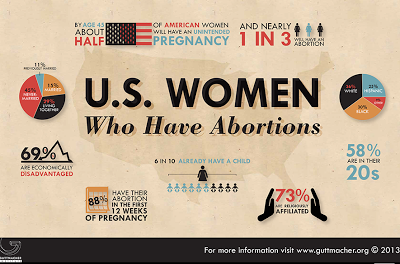
Right now there are no American women who were of reproductive age prior to Roe v. Wade , the 1973 Supreme Court decision legalizing abortion. Yet reproductive rights in the US have never been more threatened. 2011 marked the passage of the most state-level restrictive abortion laws ever. 2012 saw the second-highest. More than half of all US women of reproductive age (15–44) now live in a state that is hostile to abortion rights. Ten years ago, it was fewer than one-third. The Guttmacher Institute has produced a series of infographics to illustrate the state of reproductive rights in the US. They are encouraging allies to share them widely. What happens to women who want abortions and can't obtain one? We're finally getting some actual data to answer that question. Annalee Newitz at io9 reports. Public health researchers with the UC San Francisco group Advancing New Standards in Reproductive Health (ANSIRH) used data from 956 women who sought abortions at 30 different abort...